 GitHub
GitHub
GitHub
Interactive companions
PreprintEcoEvoRxiv · doi.org/10.32942/X2JD60
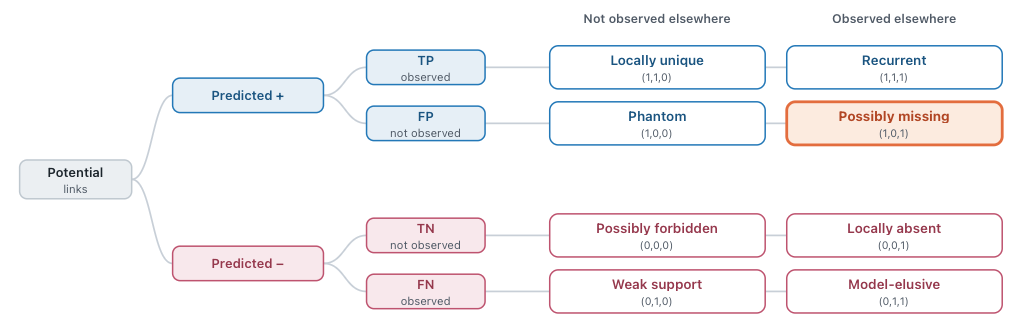
Ecological interactions shape community dynamics and stability, yet many go unrecorded. Link prediction methods attempt to tackle incomplete knowledge, but predictions are only conjectures, and validating them all in the field is neither feasible nor desirable. Furthermore, interactions differ in the action needed for their detection. Validation therefore must be guided by ecological and statistical theory. We present a guided-sampling framework that combines predictions with local and regional observations, using within-system variability across replicated networks as contextual evidence. It assigns each link to a fine-resolution, ecologically-aware taxonomy that separates conflated categories (e.g., forbidden versus undersampled interactions). Each category then implies a concrete action (e.g., sample more, change method). A Bayesian formulation quantifies confidence in each assignment and incorporates researchers' knowledge. We include a worked empirical example, and an interactive Bayesian version online (http://lpguide.ecomplab.com). Contextual evidence turns link prediction from a source of untested hypotheses into a plan for fieldwork.
Section Bayesian Inference & Supplementary Information
Assigning a category is deterministic, but every source of evidence can err. The framework therefore treats the true category as unknown and returns a posterior over all eight.
Section Empirical Demonstration
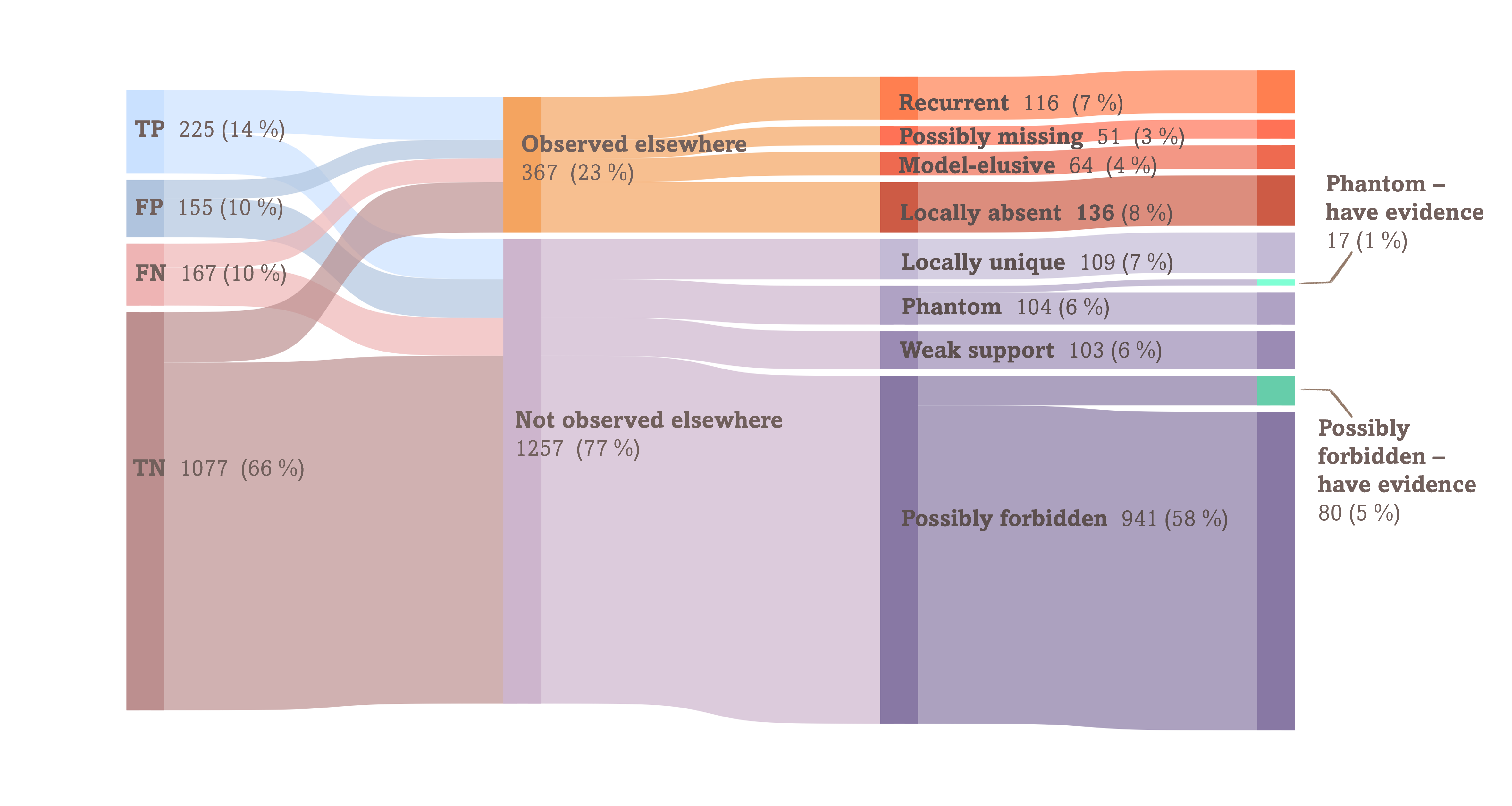
The framework applied to a real plant–pollinator system: six sites, two sampling methods, and 1624 candidate interactions sorted into where effort is actually worth spending.